Hyderabad Telangana India - 08
  • Monday to Friday, 9 AM - 6 PM
Contact Us

Content Marketing Strategy 2026: How to Build Topical Authority That Outranks Competitors

⚡ Content Marketing Playbook 2026

Build Topical Authority That Outranks Competitors

Most content fails because of strategy, not writing. Here is the systematic, 2026-ready framework SEOvengers uses to turn scattered blog posts into a search-dominating topical authority engine.

Most businesses approach content marketing backwards. They publish one post, it doesn't rank, and they conclude that "content marketing doesn't work." The real problem is almost never the writing — it's the absence of a topical strategy. In 2026, with Google's Helpful Content signals and AI-generated search results rewarding genuine expertise, the sites that win are the ones that own an entire topic, not the ones that chase isolated keywords.

This guide breaks down exactly how to build topical authority step by step — the same architecture we deploy for clients across technical SEO, local SEO, and e-commerce SEO.

What you'll learn

  • What topical authority is and why it beats random backlinks in 2026
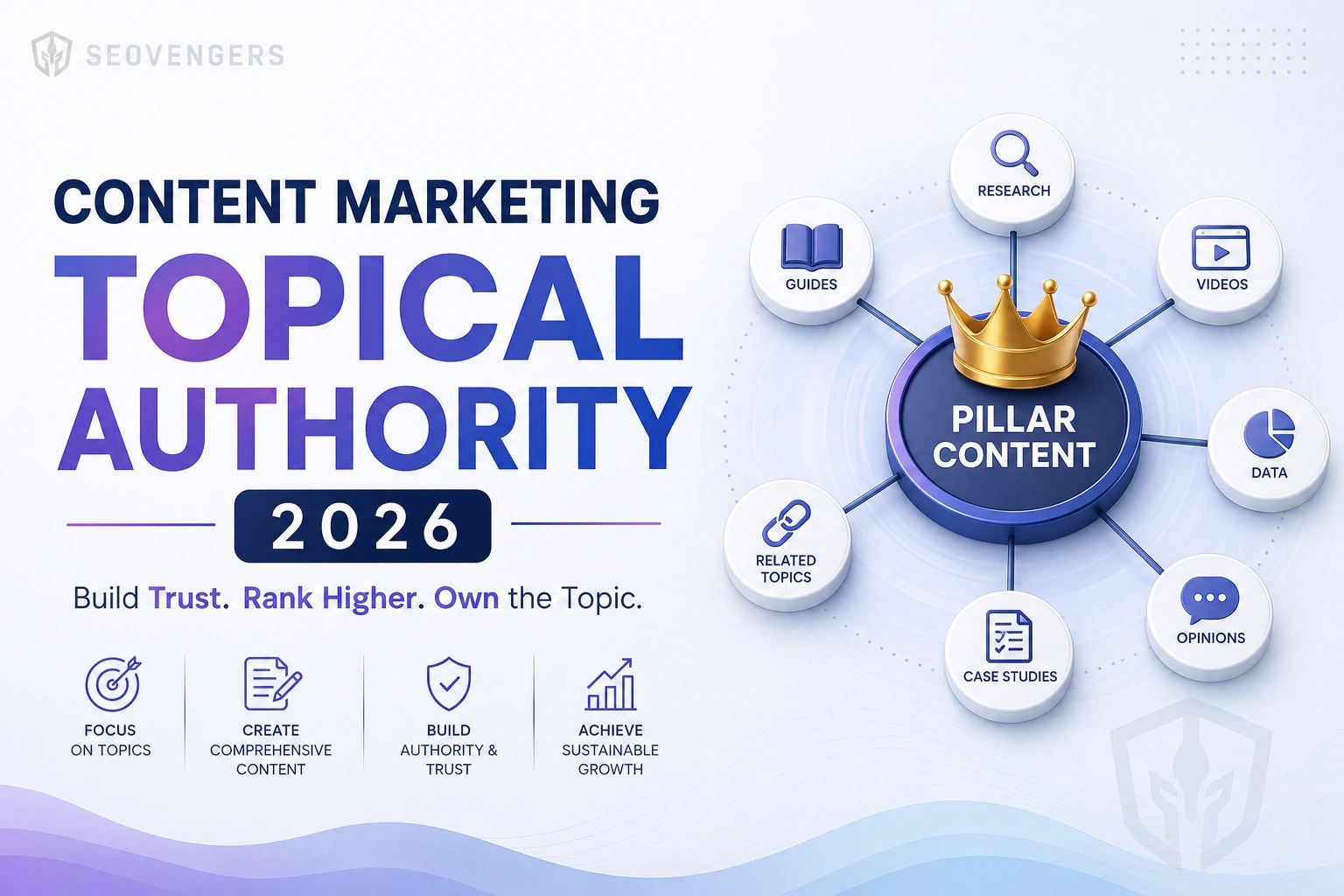
  • The pillar-and-cluster model, visualized
  • A repeatable 5-step framework to build authority on any topic
  • A strategic internal linking architecture you can copy
  • A 90-day roadmap and the metrics that prove it's working

What Is Topical Authority?

Topical authority is how confident a search engine is that your site is a genuine expert on a subject. A site that covers one topic comprehensively — answering every related question a user could have — consistently outranks a site with thin content scattered across dozens of unrelated topics, even when the comprehensive site has fewer backlinks.

Google doesn't rank pages in isolation anymore; it evaluates the topical context of your whole domain. This is reinforced by E-E-A-T (Experience, Expertise, Authoritativeness, Trust) and the Helpful Content System, both of which reward depth, first-hand experience, and content that fully satisfies intent. The mechanism for demonstrating that depth is the pillar-and-cluster (hub-and-spoke) model.

PILLAR PAGEContent Marketing Keyword Research Topic Mapping On-Page SEO Content Refresh Content Briefs Link Earning
The hub-and-spoke model: one comprehensive pillar page supported by interlinked cluster articles.

Why Topical Authority Beats Random Backlinks

Backlinks still matter — but they amplify authority you've already built; they don't replace it. A handful of deep, interconnected articles signals expertise that a pile of disconnected posts never will. Topical authority is more durable, compounds over time, and is far harder for competitors to copy than a backlink profile. Pair both and you become almost impossible to dislodge.

Step 1: Define Your Core Topics (Pillars)

Identify 3-5 core topics directly tied to your business and revenue. Each becomes a pillar: a comprehensive guide targeting a high-volume head term. Resist the urge to cover everything — depth beats breadth.

At SEOvengers our pillars are Technical SEO, Local SEO, E-Commerce SEO, Content Marketing (this guide), and Link Building. Each one targets a buyer with a real problem and maps to a service we offer.

Step 2: Map Subtopics into Clusters

For each pillar, brainstorm 8-15 subtopics that become cluster articles. Every cluster targets one specific long-tail keyword and answers a single, focused question. The rule: each cluster links up to its pillar, and the pillar links down to every cluster. That interlinking is what signals topical depth.

Pro tip: Build your cluster map from real search data — autocomplete, "People Also Ask", and competitor gaps — not from guesses. Group keywords by the question they answer, not by surface-level wording.

Step 3: Match Search Intent

A perfectly written article ranks for nothing if it answers the wrong intent. Before writing, classify the query and match the format to what the searcher actually wants:

Search intentWhat the user wantsBest content format
InformationalTo learn or understandGuides, how-tos, explainers, pillar pages
CommercialTo compare options before decidingComparisons, "best of" lists, case studies
TransactionalTo take action / buy nowService pages, product pages, demos
NavigationalTo reach a specific brand or pageBranded landing pages, About, Contact

Step 4: Write for Comprehensiveness (and E-E-A-T)

Comprehensive doesn't mean longer for the sake of word count — it means fully resolving the topic so the reader never needs another tab. Cover the obvious questions and the follow-ups. Add first-hand experience, original data, examples, and visuals. Demonstrate the "Experience" in E-E-A-T that purely AI-spun content can't fake. This is exactly why depth-led content now outperforms volume-led content.

Step 5: Build a Strategic Internal Linking Architecture

Internal links are the connective tissue of topical authority. They pass relevance and link equity, help search engines discover and contextualize pages, and prove your coverage is interconnected rather than accidental. Done right, internal linking is the single highest-leverage SEO task most sites neglect.

PILLAR (this guide)Content Marketing Technical SEO Checklist Local SEO India Guide E-Commerce SEO Guide SEO Services Client Case Study
How this very guide links: the Content Marketing pillar connects two-way to our core SEO guides, services, and proof.

The internal linking rules we follow

  • Pillar ↔ cluster, both ways. The pillar links to every cluster; each cluster links back to the pillar and to 2-3 sibling clusters.
  • Use descriptive anchor text. Link with the target's keyword (e.g., our technical SEO checklist), never "click here".
  • Link from strength to need. Point links from established pages toward newer pages that need authority.
  • Connect to money pages. Where relevant, route readers to services and proof like our client case study.

How to Measure Topical Authority

  • Share of keywords ranking within a topic cluster (rising = authority building)
  • Average position across the cluster, not just the pillar
  • Impressions & clicks for the topic in Google Search Console
  • Internal links per page and orphan-page count (should trend to zero)
  • "Also ranks for" growth — one strong page pulling in dozens of related queries

Your 90-Day Topical Authority Roadmap

Days 1-30 · Foundation

Map & publish the pillar

Choose one core topic, research the full cluster, and publish the comprehensive pillar page plus 2-3 clusters.

Days 31-60 · Depth

Fill the cluster

Publish the remaining clusters on a steady cadence, matching intent and interlinking every new piece up to the pillar.

Days 61-90 · Compound

Interlink, refresh & measure

Tighten internal links, refresh early posts, earn a few relevant backlinks, and track cluster-level rankings in GSC.

Common Mistakes to Avoid

  • Chasing unrelated keywords that dilute your topical focus
  • Publishing thin "clusters" that don't fully answer their question
  • Building a pillar but never interlinking the clusters back to it
  • Ignoring search intent and forcing a blog post where a service page belongs
  • Abandoning the topic after a month — authority compounds, it doesn't sprint

Frequently Asked Questions

What is topical authority in SEO?

It's the degree to which search engines trust your site as a comprehensive expert on a subject — earned through deep, interconnected pillar and cluster content rather than scattered one-off posts.

How long does it take to build topical authority?

Expect early movement in 60-90 days as clusters get indexed and interlinked, with authority compounding meaningfully over 4-8 months of consistent publishing.

Is topical authority more important than backlinks?

They work together, but in 2026 deep topical coverage with strong internal linking can outrank a bigger backlink profile attached to shallow content.

How many articles do I need for a topic cluster?

Typically one pillar page plus 8-15 cluster articles, each targeting a specific long-tail keyword and linking back to the pillar.

How do internal links build topical authority?

They pass relevance and equity between related pages and prove the depth and structure of your coverage — a pillar linking to every cluster (and back) is the strongest depth signal.

🦸 Want us to build your topical authority engine?

SEOvengers designs and executes pillar-and-cluster content strategies that compound into organic dominance.

⚡ Get Your Free SEO Audit

E-Commerce SEO in 2026: The Complete Guide to Ranking Product Pages on Google

E-commerce brands in India lose millions because product pages never rank. SEO fixes that permanently.

1. Category Architecture First

Each category page must target a clear keyword cluster. Use descriptive URLs like /shoes/running-shoes-men/ not /category/123/. Structure mirrors search intent, not your inventory system.

2. Optimise Category Pages

Category pages rank for high-volume head terms. Every one needs a unique H1, 150-300 words of unique content, internal links to subcategories, and BreadcrumbList schema.

3. Handle Faceted Navigation

Use noindex on filtered URLs that do not target unique keywords. Use canonical tags pointing filtered pages to the main category URL to consolidate ranking signals.

4. Write Unique Product Descriptions

Copy-pasted manufacturer descriptions put you in competition with every other reseller. Write unique, benefit-focused descriptions with target keywords included naturally and common questions answered.

5. Implement Product Schema

Product schema enables rich results in Google: price, availability, star ratings. Add Product schema, AggregateRating schema, and BreadcrumbList schema on every product page.

6. Fix Site Speed

A 1-second delay reduces conversions by 7%. Serve images in WebP, use Cloudflare CDN, lazy-load product images, and remove render-blocking scripts from product pages.

7. Internal Link Blog to Products

A guide like Best Running Shoes for Flat Feet should link directly to your flat-feet category with keyword-rich anchor text. This passes link equity from informational to transactional pages.

Grow your e-commerce organic revenue with SEOvengers

Local SEO India Guide 2026: How to Dominate Google Maps and Local Search

When someone in India searches for an SEO agency in Hyderabad or a dentist near me, Google shows a Map Pack at the top of results. Getting into that box is the goal of local SEO.

Step 1: Claim and Optimise Your Google Business Profile

Your Google Business Profile is the single most important local SEO asset you have. Claim it at business.google.com. Fill out every field: business name exactly as it appears in the real world, primary category chosen carefully, a 750-character description using your target keywords, accurate hours, and photos. Businesses with 100+ photos get significantly more calls and direction requests.

Step 2: Build Local Citations (NAP Consistency)

Your business Name, Address, and Phone number must be identical across every directory: Justdial, Sulekha, IndiaMart, Yellow Pages, and your website. Even a small difference like Pvt. Ltd. vs Private Limited confuses Google and weakens your local authority. Audit and fix every inconsistency you find.

Step 3: Generate a Steady Stream of Google Reviews

Reviews are a major local ranking factor. The number, recency, and average rating all matter. Build a system: create a short review link from your GBP dashboard, ask every satisfied customer immediately after service by SMS, and respond to every review within 24 hours. Aim for at least 2 to 4 new reviews per month.

Step 4: Create Location-Specific Landing Pages

If you serve multiple cities or areas, create a dedicated page for each. A page titled SEO Services in Hyderabad with localised content will outrank a generic services page every time. Include the city name in your H1, URL, and meta title, plus local testimonials, a Google Maps embed, and LocalBusiness schema markup.

Step 5: Earn Local Backlinks

Links from local Indian news sites, trade associations, business directories, and partner websites signal to Google that you are a trusted local entity. Sponsor local events. Get featured in local business roundups. Join your city Chamber of Commerce and get listed on their website.

Step 6: Optimise for Near Me Searches

Voice and mobile search has made near me queries explode in India. Ensure your GBP has the correct address, your website loads fast on mobile, and you have localised content answering the specific questions your local audience asks.

Local SEO Timelines for Indian Businesses

For a new or unoptimised GBP, expect Map Pack movement within 60 to 90 days with consistent effort. Competitive cities like Mumbai, Bengaluru, Delhi, and Hyderabad take longer. Tier-2 and Tier-3 cities are often much faster to dominate.

Get a free local SEO audit for your business

Technical SEO Checklist 2026: 20 Fixes That Can Double Your Organic Traffic

Most SEO guides talk about keywords and content. But if your site has technical problems, no amount of content will help you rank. Google cannot rank what it cannot crawl, render, or understand.

This checklist covers the 20 technical SEO fixes that consistently deliver the biggest ranking gains, based on our experience auditing 200+ Indian and global websites.

1. Fix Crawl Errors First

Open Google Search Console and go to the Coverage report. Any URLs marked Excluded or Error are pages Google tried to index and failed. Fix 404s with proper 301 redirects, and remove pages you do not want indexed using noindex tags or robots.txt.

2. Audit Your Core Web Vitals

LCP, INP, and CLS are ranking signals. Use PageSpeed Insights to check your scores. A score below 50 on mobile is actively hurting your rankings. Common culprits: unoptimised images, render-blocking JavaScript, and poorly chosen web fonts.

3. Implement HTTPS Sitewide

Every page, including internal redirects, must load over HTTPS. Mixed content warnings erode trust scores. Run your site through Why No Padlock to catch these before Google does.

4. Fix Duplicate Content With Canonical Tags

If Google sees your content at multiple URLs (www vs non-www, trailing slash vs no slash, UTM-tagged pages), it dilutes your ranking signal. Add a canonical tag to every page pointing to the preferred URL.

5. Optimise Your XML Sitemap

Your sitemap should include only indexable, canonical URLs. Remove 301-redirected pages, noindex pages, and error URLs. Submit it in Google Search Console every time you publish a major batch of content.

6. Structure Your Internal Links Like a Silo

Every important page should be reachable within 3 clicks from the homepage. Orphan pages get crawled infrequently and rank poorly. Run a crawl with Screaming Frog to find them.

7. Add Schema Markup to Every Key Page

Structured data helps Google understand your content and enables rich results (star ratings, FAQs, breadcrumbs). At minimum, add Organisation, WebPage, and BreadcrumbList schema. Service pages should have Service schema.

8. Fix Redirect Chains

A to B to C redirect chains waste crawl budget and dilute link equity. Every redirect should be a single hop. Run a crawl to find chains longer than one step and collapse them directly.

9. Optimise Robots.txt

Block admin directories, staging environments, and duplicate parameter URLs, but never block CSS, JavaScript, or pages you want indexed. A misconfigured robots.txt can accidentally deindex your entire site overnight.

10. Mobile-First Is Not Optional

Google indexes the mobile version of your site first. Test every page with the Mobile-Friendly Test. Pay particular attention to font sizes, tap target sizes, and viewport configuration.

What to Do Next

A full technical SEO audit surfaces issues specific to your site that no generic checklist can predict. At SEOvengers, we run a 200-point technical audit as the foundation of every engagement.

Get your free technical SEO audit

Unleashing the Power of SEO: How SEOvengers Can Transform Your Business

Unleashing the Power of SEO: How SEOvengers Can Transform Your Business

In today’s digital landscape, the success of your business often hinges on one crucial factor: your online visibility. This is where search engine optimization (SEO) comes into play. At SEOvengers, we specialize in using innovative SEO strategies to elevate your brand and boost organic traffic. Let’s dive into how we can help you dominate the digital world.

Why SEO Matters

  • Increased Visibility: The majority of online experiences begin with a search engine. By optimizing your website, you enhance its visibility on search results pages.
  • Credibility and Trust: Websites that rank higher in search results are often viewed as more credible and trustworthy by users.
  • Cost-Effective Marketing: Unlike paid advertising, organic traffic generated through SEO is ongoing and sustainable, providing long-term benefits.
  • Improved User Experience: SEO also focuses on the overall user experience, ensuring that your site is structured and easy to navigate.

Our Comprehensive SEO Services

At SEOvengers, we offer a range of SEO services designed to meet the unique needs of your business:

1. SEO Strategy Development

Our team will work closely with you to create a tailored SEO strategy that aligns with your business goals. This includes:

  • Keyword Research
  • Competitor Analysis
  • On-page SEO Optimization
  • Technical SEO Audit

2. Content Marketing

Quality content is key to successful SEO. We develop engaging and relevant content that attracts and retains customers. Our services include:

  • Blog Writing
  • Infographics Creation
  • Video Content Development

3. Social Media Management

Boosting your online presence extends beyond your website. Our social media management includes:

  • Creating a Social Media Strategy
  • Content Planning and Scheduling
  • Monitoring Engagement and Analytics

4. Analytics and Reporting

Measuring the success of our efforts is crucial. We provide:

  • Detailed Traffic Reports
  • Keyword Ranking Analysis
  • Conversion Tracking

Tips for Optimizing Your Website

While our SEO experts at SEOvengers are here to support you, here are some basic tips you can implement on your own:

  • Use Relevant Keywords: Research and incorporate relevant keywords into your content, headings, and meta descriptions.
  • Optimize Images: Use descriptive file names and alt text for all images on your website to improve visibility.
  • Improve Page Load Speeds: A slow-loading website can drive users away. Use tools like Google PageSpeed Insights to identify optimization opportunities.
  • Build Quality Backlinks: Collaborate with reputable websites to generate backlinks that improve your site’s authority and ranking.

Conclusion

In an ever-evolving digital landscape, having a robust SEO strategy is essential for any business looking to succeed. With SEOvengers on your side, you’ll have a team of dedicated professionals committed to enhancing your online visibility and driving sustainable traffic. Let us save the day for your business with our exceptional SEO solutions!

Scroll to Top