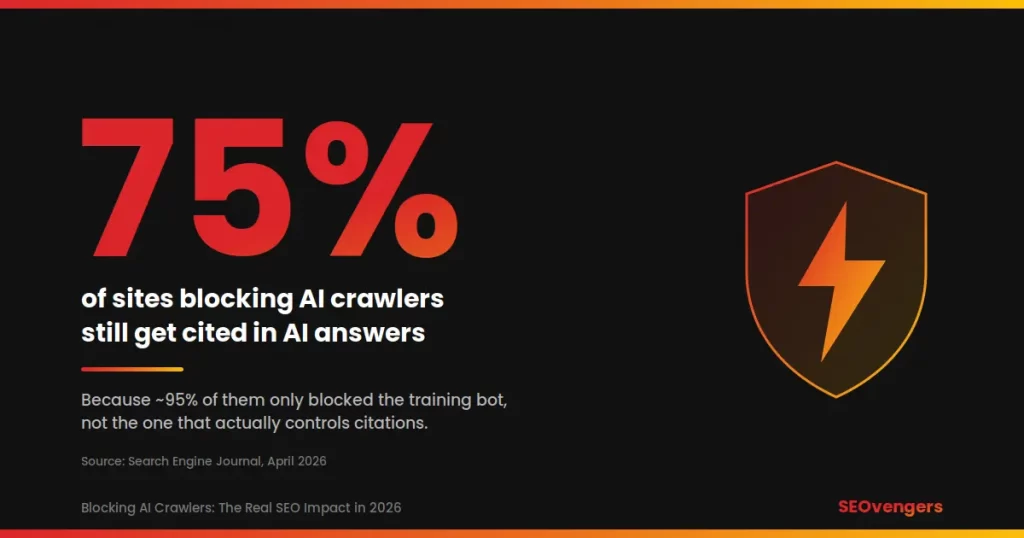
Because ~95% of them only blocked the training bot, not the one that controls citations.
TL;DR
- Blocking “AI crawlers” isn’t one decision. OpenAI, Anthropic, and Perplexity each run separate bots for training, live search citations, and user-triggered fetches, and blocking one doesn’t block the others.
- Training crawlers like GPTBot and ClaudeBot have almost no effect on today’s Google rankings or today’s AI citations. Blocking them costs you very little right now.
- Search/retrieval crawlers like OAI-SearchBot are the actual control point for AI visibility. Block those, and you drop out of ChatGPT, Claude, and Perplexity answers.
- A large share of sites that believe they’ve blocked AI still get cited anyway, usually because only the training bot was blocked, or the citation is coming from a mention on someone else’s page.
- AI referral traffic is still a small slice of total visits, but it converts several times higher than plain organic search, so this is a revenue decision, not just a technical one.
What “Blocking AI Crawlers” Actually Means
Most conversations about blocking AI still treat it like a single switch. It isn’t. OpenAI alone operates three separate, independently controlled bots, and Anthropic and Perplexity mirror the same structure. A blanket “block all AI” rule in robots.txt, or a CDN firewall setting flipped in a hurry, usually catches all three at once, which is rarely what the site owner actually wants.
The three jobs an AI crawler can do
Training crawlers gather pages that may shape a future model’s weights. GPTBot, ClaudeBot, Google-Extended, Bytespider, and CCBot sit in this bucket. None of them power what a chatbot tells a user today; they influence what a future version of the model might “know” months from now.
Search and retrieval crawlers build the index a chatbot’s search feature actually pulls from when it answers a live question. OAI-SearchBot, Claude-SearchBot, and PerplexityBot do this job, and this is the bot that determines whether a brand shows up in an answer today, not months from now.
User-triggered fetchers, like ChatGPT-User, Claude-User, and Perplexity-User, only fire when a person explicitly asks the assistant to open a specific page. OpenAI’s own documentation notes that robots.txt rules may not reliably apply to this category at all, since a human, not a schedule, initiated the request.
The crawlers to know in 2026
| Crawler | Operator | Job | Blocking it affects |
|---|---|---|---|
| GPTBot | OpenAI | Training | Future model training only |
| OAI-SearchBot | OpenAI | Search / retrieval | ChatGPT search answers, today |
| ChatGPT-User | OpenAI | User-triggered fetch | One-off reads a user requests |
| ClaudeBot | Anthropic | Training | Future model training only |
| Claude-SearchBot | Anthropic | Search / retrieval | Claude’s live citations |
| Claude-User | Anthropic | User-triggered fetch | One-off reads a user requests |
| PerplexityBot | Perplexity | Search / retrieval | Perplexity’s live citations |
| Google-Extended | Training (Gemini) | Gemini training only, not Search or AI Overviews | |
| Bytespider / CCBot | ByteDance / Common Crawl | Training | Downstream models trained on the corpus |
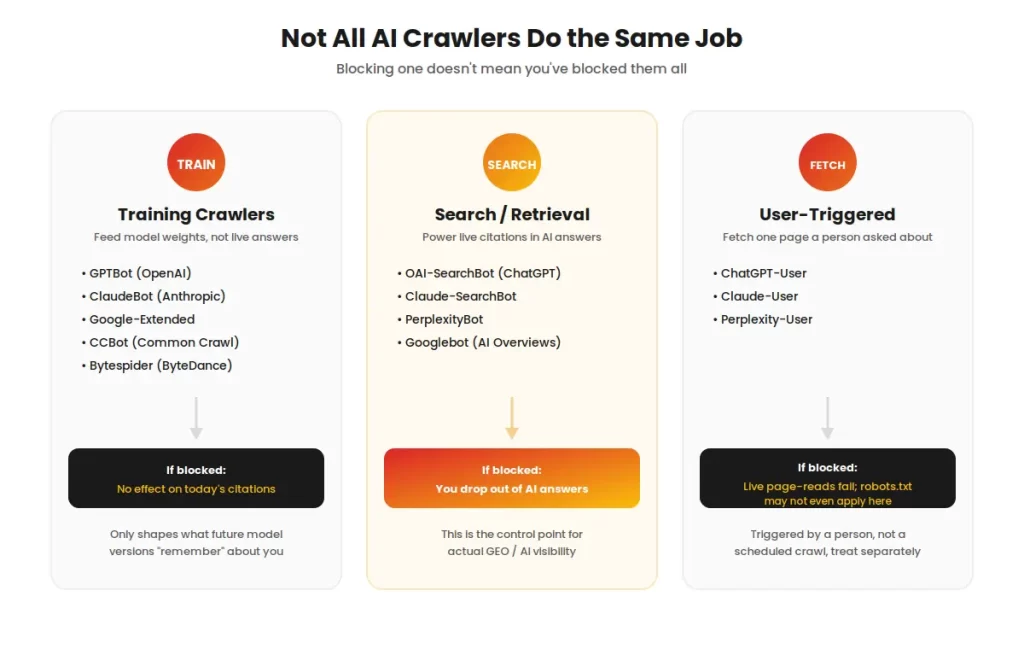
GPTBot and ClaudeBot handle training. OAI-SearchBot and PerplexityBot handle live citations. ChatGPT-User handles one-off page reads.
Treating all of these as one “AI bot” decision is where most misconfigurations start. A robots.txt file written in 2022 or 2023, before most of the search-specific tokens existed, is very likely blocking or allowing the wrong thing without anyone realizing it.
What Actually Changes When You Block Them
This is where a lot of the anxiety around “blocking AI” is misplaced. Blocking a training crawler like GPTBot or ClaudeBot has no bearing on Google or Bing rankings, because those run on entirely separate crawler systems, Googlebot and Bingbot, with their own schedules and their own indexes. Blocking a training crawler also has close to no effect on whether ChatGPT or Claude cite a brand today, because training and live retrieval are handled by different bots with independently configurable robots.txt rules, something OpenAI states directly in its own crawler documentation: a webmaster can allow OAI-SearchBot to stay visible in search results while disallowing GPTBot to opt out of training, and the two settings don’t interact.
What blocking does change is narrower than “AI visibility” as a blanket concept. Block a search/retrieval bot like OAI-SearchBot, and the consequence is direct: content stops appearing in ChatGPT’s search answers, though it may still surface as a bare, unenriched navigational link. That’s the actual lever. Everything else is closer to a training-data opt-out than a visibility switch, and treating the two as the same decision is how well-intentioned teams end up either giving away more than they meant to, or losing visibility they never meant to lose.
Why Blocked Sites Still Show Up in ChatGPT Answers
This is the part that trips people up, and it mirrors an anomaly a well-known SEO consultant flagged recently on LinkedIn: a site configured to block every OpenAI crawler was still turning up, heavily, in ChatGPT’s answers to brand-related questions. That isn’t a bug. A handful of mechanisms explain most cases like it:
- The block was applied to GPTBot only, not to OAI-SearchBot, which is a common and, per OpenAI’s own documentation, entirely valid configuration: allow search, block training.
- The citation is coming from a mention of the brand on a page the model can access, a review site, a news writeup, a forum thread, rather than from the blocked page itself.
- The model is drawing on what it already absorbed during training, before the block was ever put in place. Retroactively blocking a crawler doesn’t erase what’s already baked into a model’s weights.
- Search-index metadata, titles, snippets, and structured data that a general web index already holds, can get pieced together with other retrieved sources even when the underlying page was never fetched directly by that specific assistant.
The scale of this isn’t anecdotal. Search Engine Journal reported in April 2026 that roughly three-quarters of sites blocking OpenAI’s or Google’s AI bots still turned up in AI citations, and that about 95% of those cited-but-blocked pages had only blocked the training bots, not the search bots. A separate study cross-referencing robots.txt rules against citation data across more than a thousand highly-visible domains found the mirror-image failure mode: sites that block a provider’s own search/retrieval bot see citation rates from that specific provider collapse toward zero, while blocking an unrelated provider’s bot barely moves the needle on the others.
The practical read either way is the same: whether a brand shows up in AI answers is mostly not a matter of “did we block AI.” It’s a matter of which specific bot got blocked, and whether the information circulating about the brand elsewhere on the web is accurate, since that’s what fills the gap whenever the origin page itself is unreachable.
The Cloudflare Default-Block Problem
A meaningful share of “we blocked AI on purpose” cases are actually “we didn’t realize Cloudflare blocked AI for us.” Cloudflare became the first major infrastructure provider to block AI crawlers by default, and independent testing has confirmed that brand-new domains onboard with AI bot blocking already switched on, before the site owner has touched a single setting.
The policy kept evolving through 2026. Since July 1, Cloudflare has managed AI crawler access across three separate categories, Search, Agent, and Training, replacing the old blanket “block AI bots” toggle. From September 15, 2026, Cloudflare evaluates any crawler that serves more than one purpose, and it names Googlebot specifically as an example, under whichever applicable rule is the most restrictive. In practice, that means a training-only block set casually months earlier can start catching Googlebot, Applebot, and Bingbot too, an outcome almost nobody actually intends. Anyone running a technical audit this year has a genuine reason to check the security settings for AI crawler rules that were switched on by default rather than chosen deliberately, since even among prominent domains, most robots.txt files still don’t explicitly address the newer search-specific tokens at all, which usually means the CDN layer, not the robots.txt file, is quietly making the decision instead.
Not All Crawlability Equals Citation: The Wider GEO Picture
Being reachable by the right bot is necessary, but it isn’t sufficient on its own. The Princeton-led GEO (Generative Engine Optimization) study, the first large-scale academic look at what actually improves AI citation rates, tested nine content interventions across thousands of queries. The three that moved the needle most were adding specific statistics, adding attributable quotations, and citing outside sources within the content itself, each worth roughly a 30 to 40 percent lift in citation likelihood. Keyword stuffing, by contrast, produced no benefit and a slight penalty on at least one engine tested.
Two findings from more recent 2026 research are worth knowing precisely because they cut against common assumptions. First, schema markup on its own showed no measurable uplift in citation rates on AI Overviews, AI Mode, or ChatGPT in a mid-2026 Ahrefs analysis, despite widespread advice treating it as a prerequisite. Second, an audit of a million-plus AI citations found that roughly seven in ten cited sites had at least one technical barrier, a robots rule, a CDN challenge, or content hidden behind client-side JavaScript, quietly limiting how much of their site an AI crawler could actually see. Crawler policy is the access layer. Content quality, structure, and accurate third-party mentions are what convert that access into an actual citation.
Why This Actually Matters for Convertible Traffic and Brand Presence
Visibility in AI answers isn’t a vanity metric. The traffic that does arrive from AI platforms converts meaningfully better than plain organic search, across every study published so far. Semrush’s 2026 cross-industry dataset puts AI-driven visitors at roughly 4.4 times the conversion rate of standard organic traffic. Ahrefs found an even starker gap in its own numbers: AI search made up just half a percent of its total traffic, yet drove over 12% of signups, more than a twentyfold conversion advantage. Adobe’s retail data shows a similar pattern, with AI-referred shoppers converting noticeably better and spending more time on product pages than non-AI visitors, and Shopify’s merchant data points the same direction for ecommerce specifically.
The volume is still small, typically somewhere around one to six percent of total traffic depending on the study and the industry, but it’s growing fast, and the visitors who do arrive tend to have already done their research through the assistant before they ever click through, which is part of why they convert at the rate they do. That combination, small in volume but high in intent and conversion value, is exactly why blocking the wrong crawler is a business decision with a revenue line attached to it, not a technical footnote to leave entirely to the dev team. It’s also worth noting that most analytics setups still misattribute this traffic as “direct” rather than tracking it as its own channel, so a brand can be losing or gaining AI referral traffic without anyone on the marketing side noticing the shift in the reporting.
Choosing an AI Crawler Policy by Business Type
There’s no single correct answer for every business, and the right call depends heavily on what the content actually is and who benefits if a model can read it for free.
| Business type | Typical call | Why |
|---|---|---|
| SaaS or service brand chasing visibility | Block training, allow search and user-fetch | The goal is to be cited and clicked, not just memorized for free |
| Publisher, paywalled or ad-supported | Block broadly, or explore pay-per-crawl | Training bots consume the asset without paying the publisher for it |
| Ecommerce | Block training, allow search and user-fetch | AI-referred orders carry a documented conversion and order-value premium |
| Proprietary or licensed data holders | Block broadly by default | The downside of leakage outweighs the citation upside |
| Local / multi-location service business | Block training, allow search | Accuracy of official branded information matters even where volume is modest |
A SaaS brand and a paywalled newsroom can reasonably land on opposite policies for the exact same crawler, and both would be correct given what each one is protecting.
A Practical robots.txt Baseline for 2026
For a business that wants AI citation eligibility without handing over free training data, the widely used middle-ground configuration looks roughly like this:
User-agent: GPTBot
Disallow: /

User-agent: OAI-SearchBot
Allow: /

User-agent: ChatGPT-User
Allow: /

User-agent: ClaudeBot
Disallow: /

User-agent: Claude-SearchBot
Allow: /

User-agent: PerplexityBot
Allow: /
This keeps the training bots out while leaving the door open for search and user-triggered access, the two categories that actually put a brand in front of someone asking a question. Search-related changes typically show up in AI search behavior within about 24 hours; training-related changes can take considerably longer to be reflected, since that runs on a slower, separate update cycle.
It’s also worth treating llms.txt, the emerging file some sites publish alongside robots.txt to describe their content to AI systems, as a supplementary signal rather than an enforceable control. No major AI provider has committed to treating it as binding the way robots.txt is generally respected, so it’s a “nice to have” clarity layer, not a substitute for getting the crawler-specific robots.txt rules right.
Auditing Whether You’re Blocked by Accident
A short checklist covers most of what actually goes wrong in practice:
- Pull the live robots.txt and check the rule for each named crawler individually, not just a generic “AI” line that may not exist at all.
- Check the CDN or WAF, Cloudflare in particular, for AI bot rules that may have been switched on automatically rather than chosen deliberately.
- Request a key page using a crawler-identifying user agent and confirm it returns a normal response rather than a challenge or block page.
- Check server logs for GPTBot, OAI-SearchBot, ClaudeBot, Claude-SearchBot, and PerplexityBot activity to see who is actually reaching the site right now.
- Track whether the brand is being cited in AI answers at all, and if it is, whether the citation actually points back to the site itself or to a third party talking about the brand instead.
Doing this once a quarter is enough for most businesses; the crawler landscape and the CDN defaults around it have both changed enough in the past year that a robots.txt file left untouched since last year is genuinely likely to be out of date.
Which Industries This Applies To
This decision touches almost anyone running organic or paid marketing, but it bites hardest for a specific set of businesses:
- SaaS and B2B software brands, where buyers increasingly research vendors through an assistant before ever visiting a website directly.
- Ecommerce and DTC brands, where AI-referred orders already show a measurable conversion and average-order-value premium over plain organic traffic.
- Local and multi-location service businesses, where accuracy of “official” branded information in an AI answer matters even while referral volume is still modest.
- Publishers and content sites weighing content-licensing revenue, such as pay-per-crawl arrangements, against citation-driven referral traffic.
- Agencies and in-house SEO or marketing teams running technical audits, since a single misconfigured CDN rule can quietly undo months of content and content-strategy work.
FAQ
Does blocking GPTBot hurt my Google rankings?
No. GPTBot and Googlebot are entirely separate crawler systems run by different companies, and blocking one has no direct bearing on the other, unless a broad wildcard rule accidentally catches both at once.
What is the actual SEO impact of blocking AI crawlers?
Blocking a training crawler like GPTBot or ClaudeBot has close to no immediate impact on either Google rankings or today’s AI citations. Blocking a search or retrieval crawler like OAI-SearchBot is the move that actually removes a brand from AI-generated answers.
Why does my site still get cited in ChatGPT if I blocked GPTBot?
Because GPTBot only controls training. Citations come from OAI-SearchBot, the search bot, and ChatGPT-User, the live-fetch bot, both independent settings, plus third-party mentions the model can still read even when the brand’s own page is blocked.
Should ecommerce sites block AI crawlers?
Most ecommerce brands are better off blocking only the training bots, since AI-referred orders have shown a documented conversion and order-value premium over plain organic search across multiple 2026 studies.
Does Cloudflare block AI crawlers automatically?
Yes, on new domains Cloudflare has enabled AI bot blocking by default, and its 2026 policy groups crawlers into Search, Agent, and Training categories, with multi-purpose crawlers like Googlebot evaluated under whichever rule is most restrictive starting September 2026.
How long does it take for a robots.txt change to affect AI search visibility?
Search-related changes typically show up within about 24 hours. Training-related changes can take considerably longer to be reflected, since that runs on a separate, slower model-update cycle.
Final Thoughts
The honest version of this topic is less dramatic than “block AI and lose everything,” and less safe than “block AI and lose nothing.” It’s a bot-by-bot decision, and the businesses getting it right in 2026 are the ones auditing their actual robots.txt file and CDN settings rather than assuming a blanket rule did what they meant it to do. Given what a single AI-referred conversion is already worth relative to a plain organic one, that audit is worth an afternoon of anyone’s time this quarter, not a someday item on a backlog.