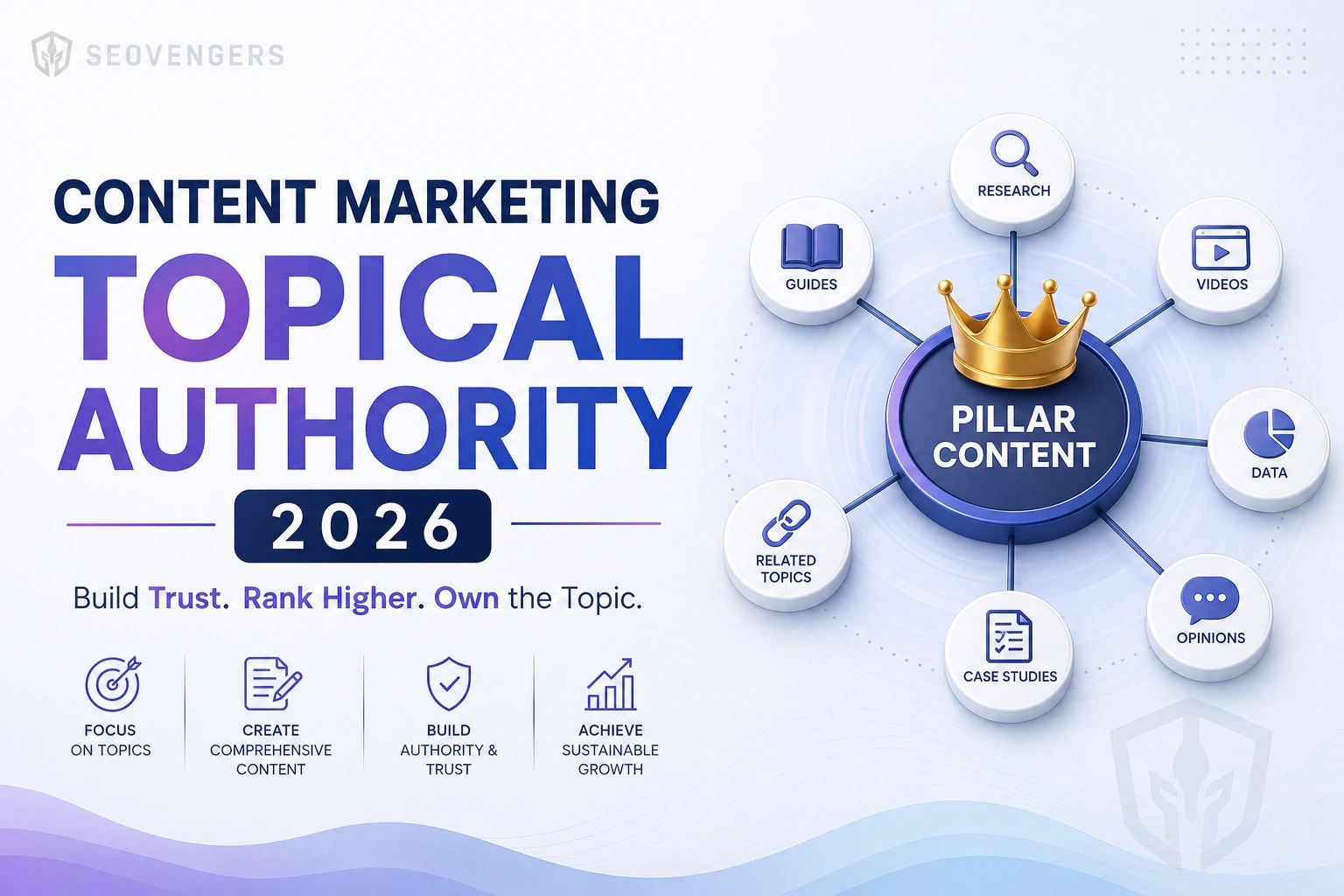
Build Topical Authority That Outranks Competitors
Most content fails because of strategy, not writing. Here is the systematic, 2026-ready framework SEOvengers uses to turn scattered blog posts into a search-dominating topical authority engine.
Most businesses approach content marketing backwards. They publish one post, it doesn't rank, and they conclude that "content marketing doesn't work." The real problem is almost never the writing — it's the absence of a topical strategy. In 2026, with Google's Helpful Content signals and AI-generated search results rewarding genuine expertise, the sites that win are the ones that own an entire topic, not the ones that chase isolated keywords.
This guide breaks down exactly how to build topical authority step by step — the same architecture we deploy for clients across technical SEO, local SEO, and e-commerce SEO.
What you'll learn
- What topical authority is and why it beats random backlinks in 2026
- The pillar-and-cluster model, visualized
- A repeatable 5-step framework to build authority on any topic
- A strategic internal linking architecture you can copy
- A 90-day roadmap and the metrics that prove it's working
What Is Topical Authority?
Topical authority is how confident a search engine is that your site is a genuine expert on a subject. A site that covers one topic comprehensively — answering every related question a user could have — consistently outranks a site with thin content scattered across dozens of unrelated topics, even when the comprehensive site has fewer backlinks.
Google doesn't rank pages in isolation anymore; it evaluates the topical context of your whole domain. This is reinforced by E-E-A-T (Experience, Expertise, Authoritativeness, Trust) and the Helpful Content System, both of which reward depth, first-hand experience, and content that fully satisfies intent. The mechanism for demonstrating that depth is the pillar-and-cluster (hub-and-spoke) model.
Why Topical Authority Beats Random Backlinks
Backlinks still matter — but they amplify authority you've already built; they don't replace it. A handful of deep, interconnected articles signals expertise that a pile of disconnected posts never will. Topical authority is more durable, compounds over time, and is far harder for competitors to copy than a backlink profile. Pair both and you become almost impossible to dislodge.
Step 1: Define Your Core Topics (Pillars)
Identify 3-5 core topics directly tied to your business and revenue. Each becomes a pillar: a comprehensive guide targeting a high-volume head term. Resist the urge to cover everything — depth beats breadth.
At SEOvengers our pillars are Technical SEO, Local SEO, E-Commerce SEO, Content Marketing (this guide), and Link Building. Each one targets a buyer with a real problem and maps to a service we offer.
Step 2: Map Subtopics into Clusters
For each pillar, brainstorm 8-15 subtopics that become cluster articles. Every cluster targets one specific long-tail keyword and answers a single, focused question. The rule: each cluster links up to its pillar, and the pillar links down to every cluster. That interlinking is what signals topical depth.
Step 3: Match Search Intent
A perfectly written article ranks for nothing if it answers the wrong intent. Before writing, classify the query and match the format to what the searcher actually wants:
| Search intent | What the user wants | Best content format |
|---|---|---|
| Informational | To learn or understand | Guides, how-tos, explainers, pillar pages |
| Commercial | To compare options before deciding | Comparisons, "best of" lists, case studies |
| Transactional | To take action / buy now | Service pages, product pages, demos |
| Navigational | To reach a specific brand or page | Branded landing pages, About, Contact |
Step 4: Write for Comprehensiveness (and E-E-A-T)
Comprehensive doesn't mean longer for the sake of word count — it means fully resolving the topic so the reader never needs another tab. Cover the obvious questions and the follow-ups. Add first-hand experience, original data, examples, and visuals. Demonstrate the "Experience" in E-E-A-T that purely AI-spun content can't fake. This is exactly why depth-led content now outperforms volume-led content.
Step 5: Build a Strategic Internal Linking Architecture
Internal links are the connective tissue of topical authority. They pass relevance and link equity, help search engines discover and contextualize pages, and prove your coverage is interconnected rather than accidental. Done right, internal linking is the single highest-leverage SEO task most sites neglect.
The internal linking rules we follow
- Pillar ↔ cluster, both ways. The pillar links to every cluster; each cluster links back to the pillar and to 2-3 sibling clusters.
- Use descriptive anchor text. Link with the target's keyword (e.g., our technical SEO checklist), never "click here".
- Link from strength to need. Point links from established pages toward newer pages that need authority.
- Connect to money pages. Where relevant, route readers to services and proof like our client case study.
How to Measure Topical Authority
- Share of keywords ranking within a topic cluster (rising = authority building)
- Average position across the cluster, not just the pillar
- Impressions & clicks for the topic in Google Search Console
- Internal links per page and orphan-page count (should trend to zero)
- "Also ranks for" growth — one strong page pulling in dozens of related queries
Your 90-Day Topical Authority Roadmap
Map & publish the pillar
Choose one core topic, research the full cluster, and publish the comprehensive pillar page plus 2-3 clusters.
Fill the cluster
Publish the remaining clusters on a steady cadence, matching intent and interlinking every new piece up to the pillar.
Interlink, refresh & measure
Tighten internal links, refresh early posts, earn a few relevant backlinks, and track cluster-level rankings in GSC.
Common Mistakes to Avoid
- Chasing unrelated keywords that dilute your topical focus
- Publishing thin "clusters" that don't fully answer their question
- Building a pillar but never interlinking the clusters back to it
- Ignoring search intent and forcing a blog post where a service page belongs
- Abandoning the topic after a month — authority compounds, it doesn't sprint
Frequently Asked Questions
What is topical authority in SEO?
It's the degree to which search engines trust your site as a comprehensive expert on a subject — earned through deep, interconnected pillar and cluster content rather than scattered one-off posts.
How long does it take to build topical authority?
Expect early movement in 60-90 days as clusters get indexed and interlinked, with authority compounding meaningfully over 4-8 months of consistent publishing.
Is topical authority more important than backlinks?
They work together, but in 2026 deep topical coverage with strong internal linking can outrank a bigger backlink profile attached to shallow content.
How many articles do I need for a topic cluster?
Typically one pillar page plus 8-15 cluster articles, each targeting a specific long-tail keyword and linking back to the pillar.
How do internal links build topical authority?
They pass relevance and equity between related pages and prove the depth and structure of your coverage — a pillar linking to every cluster (and back) is the strongest depth signal.
🦸 Want us to build your topical authority engine?
SEOvengers designs and executes pillar-and-cluster content strategies that compound into organic dominance.
⚡ Get Your Free SEO Audit